A lower interest rate sounds like straightforward good news for stocks: borrowing can become cheaper and future profits may look more valuable. But markets also ask why policy changed and how much was already expected. The same announced cut can accompany optimism about inflation or anxiety about a weakening economy.
.jpg)
.jpg#Licensing)
There are two sides to the valuation equation
A business is worth something because of the cash it may deliver in the future. A discount rate translates those uncertain future amounts into a value today. A lower discount rate, with everything else unchanged, increases that present value. The phrase “everything else unchanged” does a great deal of work, because expected profits can change at the same time.
Consider a deliberately simplified one-year payment of $110. Discounted at 10%, it is worth $100 today; discounted at 5%, it is worth about $104.76. But if the expected payment falls to $100 while the discount rate falls to 5%, its present value becomes about $95.24. Lower rates did not offset the weaker cash-flow expectation. This is arithmetic, not a valuation of a particular security.
Policy is not every borrowing rate
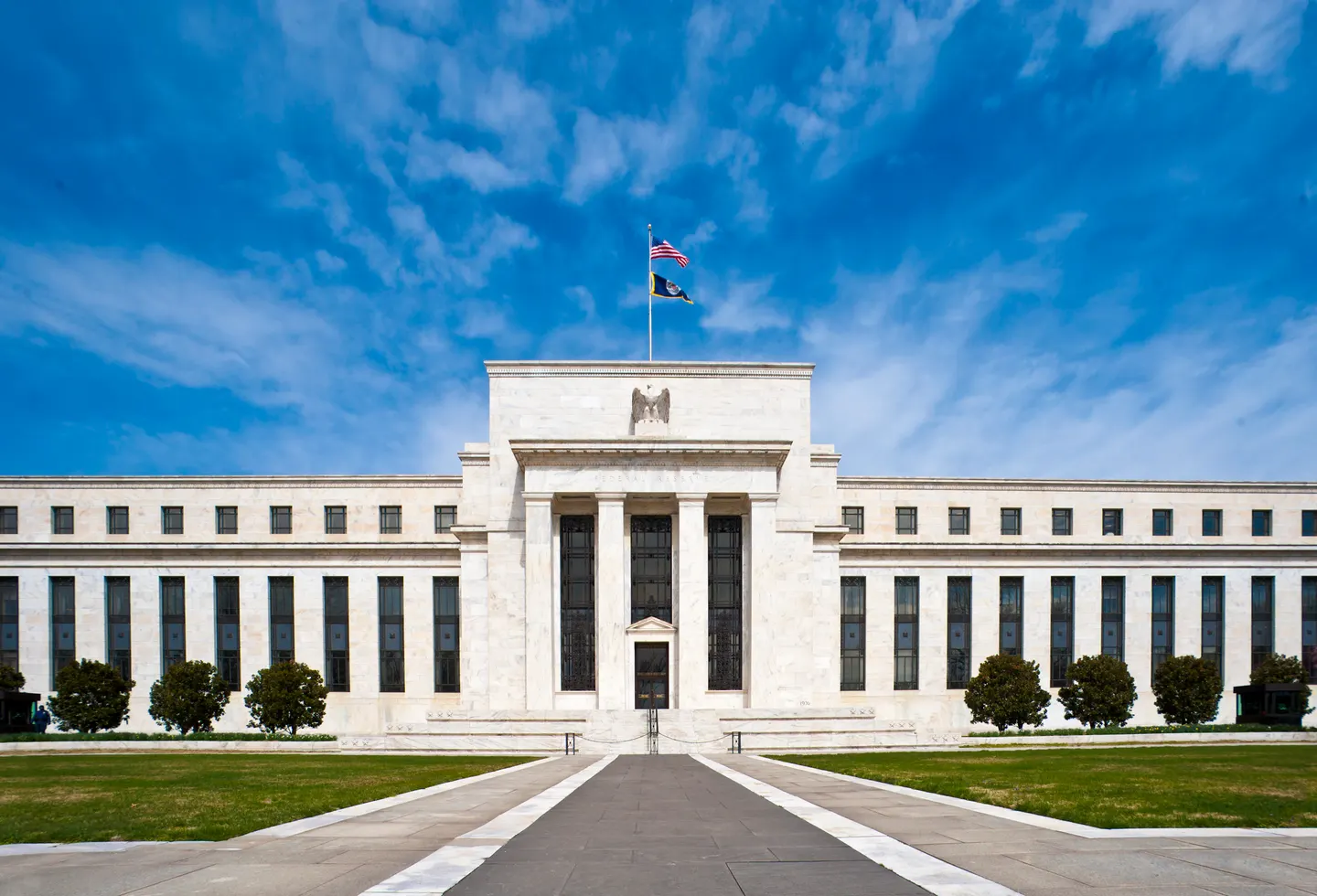
The Federal Reserve’s operating framework influences short-term market rates. A household mortgage or a company bond, however, also reflects maturity, credit risk, funding conditions and lender pricing. Long-term yields can move differently from the announced policy change because investors reassess inflation or the future path of short-term rates.
That distinction is especially important for businesses refinancing debt. A company with fixed-rate borrowing maturing years from now may see little immediate change in interest expense. Another with floating-rate debt may experience a quicker transmission. Read the debt maturity schedule rather than treating all borrowers as equally sensitive to one meeting.
Prices react to the surprise
Markets trade before the official announcement. If most participants already expected a cut, that possibility can be reflected in prices ahead of time. The new information may instead be the policy statement, projections or a change in the expected sequence of later decisions. An apparently generous cut can disappoint a market that anticipated even more easing.
A useful event note records the release time, the actual decision and what credible evidence showed expectations beforehand. Then compare the stock move with bond yields and the wider market. Be wary of a single sentence claiming a decision caused every price change during a day that also contained earnings releases or geopolitical news.
Build a scenario table in words
Under one scenario, inflation slows while demand remains resilient. Under another, policy eases because spending and employment weaken sharply. Lower financing costs can matter in both, but the earnings outlook differs. Treat these as possible mechanisms to examine rather than labels that a single data release can settle.
For your next central-bank headline, ask three questions: what changed in the expected rate path, what changed in the growth outlook, and which part was a surprise? Then look for follow-through across more than one trading session. There is no reliable rule that a cut must be followed by a rally, and a historical pattern is not a guarantee for the next policy cycle.
I would be wary of treating a rate cut as an automatic invitation to buy. The reason for the cut can matter as much as its size, especially when a lower discount rate arrives alongside weaker earnings expectations.
My reading of a rate cut
A rate cut changes both financing expectations and the story about growth. The reason and the surprise matter.
Will a Fed cut immediately lower every mortgage rate?
No. Mortgage rates also reflect longer-term market yields, credit conditions and lender pricing; some changes may already be priced in.
Sources & further reading
Source material reviewed Sep 6, 2026. These links support the factual background. Worked examples and editorial interpretations are identified in the text.
Join the conversation
What would you add, question or explain differently? Please discuss the idea and respect the person.
Comments are screened for spam and abuse. Some are held for review. We store your comment and a daily security identifier; see privacy. Keep personal contact details out of your comment.