Seeing that Jakarta airport reopened can bring immediate relief after a cancellation or an uncertain night. It is also easy to feel frustrated when an airline app still shows a delay, because “open” sounds like a promise that the timetable has reset. AirNav Indonesia said Soekarno-Hatta resumed operations at 00:30 Western Indonesia Time on September 8, 2026 after volcanic ash disruption, while warning pilots that ash remained in the flight information region. The practical question is not whether the airport gate is unlocked; it is whether one particular aircraft, crew and route are ready to move.
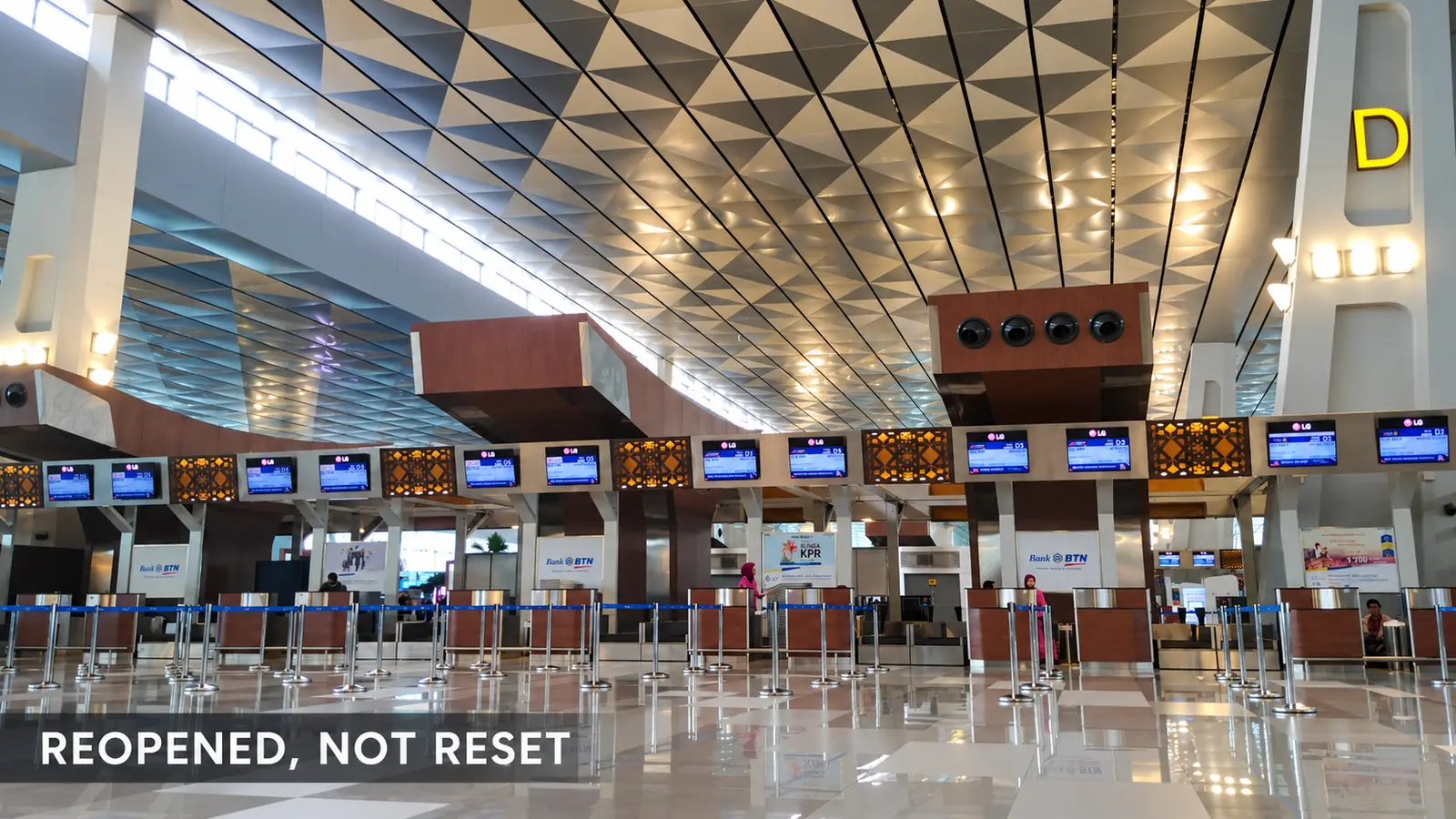

“Open” describes an airport condition, not your booking
AirNav announced reopening through a NOTAM, a formal notice that tells aviation operators about a temporary condition affecting a flight. The notice restored airport operations, but it did not certify every scheduled departure as on time. The same update said ash was still detected in the Jakarta flight information region and advised pilots to remain cautious. Reopening therefore removed one operational barrier while leaving airlines to judge individual flights against weather, ash observations, aircraft condition and route restrictions.
That distinction explains why the airport page, the airline page and the departure board can show different states without one of them necessarily being wrong. An airport can accept movements while a carrier cancels a specific service because its aircraft is elsewhere or still needs inspection. Check the exact flight number and date with the operating carrier—the airline actually flying the aircraft, which may differ from the brand that sold a codeshare ticket. A general airport headline is useful context, but it is not boarding confirmation.
A network restarts in rotations, not all at once
The Associated Press reported that 2,961 flights, including 622 international services, and about 341,000 passengers were affected during the disruption. Reuters reported that airlines had to inspect 178 grounded aircraft. Those numbers describe the scale of a network problem; they do not mean every affected passenger remained stranded after reopening. They do show why recovery can take longer than switching a runway status from closed to open.
An aircraft rotation is the sequence of legs one plane is scheduled to fly during a day. If the aircraft meant for a 14:00 departure is still completing a delayed morning sector, the afternoon flight may move even though its own airport is open. Crews have legal duty-time limits, gates must be reassigned, baggage must be reconciled and maintenance checks cannot be skipped. A recovery schedule is the carrier’s attempt to rebuild those linked resources. The first departing flight is evidence of progress, not proof that the whole network is normal.
A hypothetical timeline shows where the delay survives
Suppose, purely as an example, an airport reopens at 00:30 and a traveler has a 14:00 flight. The assigned aircraft was due to arrive at 11:30, but its preceding departure moved four hours later during the closure. Even with a one-hour turnaround after arrival, the earliest plausible departure becomes 16:30: 15:30 arrival plus one hour. This arithmetic does not forecast any real Jakarta flight. It shows why counting 13.5 hours from reopening to the ticketed time ignores the aircraft’s earlier legs.
Now add a separate ticket departing from another city at 19:00. A 16:30 departure and two-hour flight would leave only 30 minutes before the next service, before deplaning, baggage collection or a terminal change. The connection may be impossible even though both flights operate. A protected connection on one booking is usually handled under the carrier’s contract, while separate tickets may leave the traveler carrying more risk. Confirm the booking structure and minimum connection needs before accepting a replacement that merely looks earlier.
Use a confirmation ladder before travelling to the terminal
First read the airport or AirNav notice for the operational status and time. Second, open the operating airline’s app or website and search the exact flight number for the correct date. Third, check the inbound aircraft or preceding sector if the airline provides it, but treat third-party trackers as clues rather than authority. Fourth, verify the whole itinerary: connection, terminal, baggage transfer and any visa or overnight requirement. Finally, save the airline message or reference number before changing transport or accommodation.
A status marked “scheduled” is not the same as a reconfirmation, and a push notification can arrive after an operations desk has already changed the plan. If the trip matters urgently, use two official channels—such as the airline app and its service desk—and ask whether the flight is operating, not only whether the airport is open. This method is useful during an active recovery. It is less helpful for a normal day with no disruption, when repeatedly refreshing several sources may add anxiety without improving the decision.
Protect the next decision even when the cause is uncertain
Before cancelling on your own, ask what the airline is offering: rebooking, a refund, a waiver or only a status update. Keep receipts for reasonable meals, ground transport and accommodation, and request the written reason for the disruption if available. Entitlements depend on the carrier, itinerary, ticket terms and applicable law; volcanic ash and later operational knock-on effects may not be treated identically. This article cannot determine compensation for an individual booking.
My view is that reopening news should change the traveler’s question from “Is everything normal?” to “Which part of my itinerary is now confirmed?” AirNav’s notice, the airline’s flight record and the booking conditions answer different parts of that question. When they are kept separate, a traveler can welcome the reopening without mistaking a system-level improvement for a promise about one seat.
Reopening is a checkpoint, not an all-clear
The September 8 reopening was a meaningful operational step, and official notices showed that monitoring continued because ash had not simply ceased to matter. Recovery still had to pass through aircraft inspections, rotations, crew availability and individual airline decisions. That is why an open airport and a delayed flight can both be true at the same time.
Use the headline to begin checking, not to stop checking. Confirm the exact flight with the operating carrier, test every onward connection, preserve written notices and receipts, and avoid voluntary changes until you understand the options. The airport’s status tells you that movement is possible; the completed confirmation ladder tells you whether your particular journey is ready.
Reopening is a checkpoint, not an all-clear
Treat reopening as the start of recovery. Confirm the exact flight, operating carrier, aircraft rotation, connection and written options before leaving for the airport or cancelling.
Should I travel to Soekarno-Hatta as soon as the airport reopens?
Not automatically. Check the exact flight and date with the operating airline, review every connection and keep its written instructions. An open airport does not confirm each departure.
Sources & further reading
Source material reviewed Sep 8, 2026. These links support the factual background. Worked examples and editorial interpretations are identified in the text.
Join the conversation
What would you add, question or explain differently? Please discuss the idea and respect the person.
Comments are screened for spam and abuse. Some are held for review. We store your comment and a daily security identifier; see privacy. Keep personal contact details out of your comment.